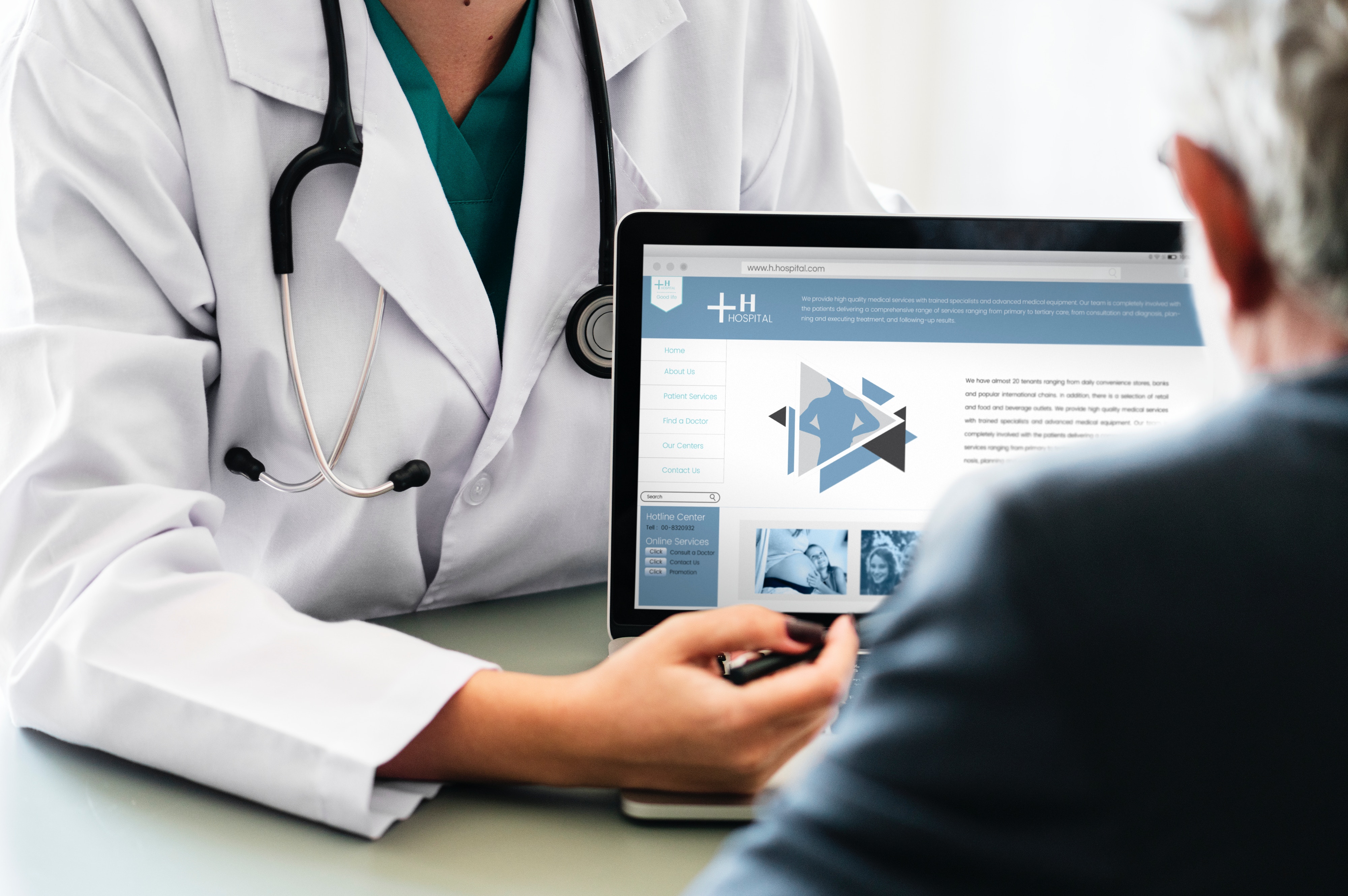
With most of our lives being spent online, it’s important for health services to catch up and keep current with its users. At first in 1950s, IT in any form has only been used by the operational blocks of healthcare (e.g. HR and accounting) (Haggerty, 2017) . The rising use and benefits of digital economies created a big opportunity for most sectors out there. Therefore, it would be silly to overlook this within the healthcare sector. In fact, more than 70% of all patients expect to use a digital service to access health services. Players in the healthcare industry benefited from the first and second waves of digitalization. However, it was hard to manage the stakeholders, regulations, and privacy concerns required to build a fully integrated healthcare IT system (Biesdorf & Niedermann, 2014). This is partly because these waves of IT adoption focused more on processes and less on patient needs.
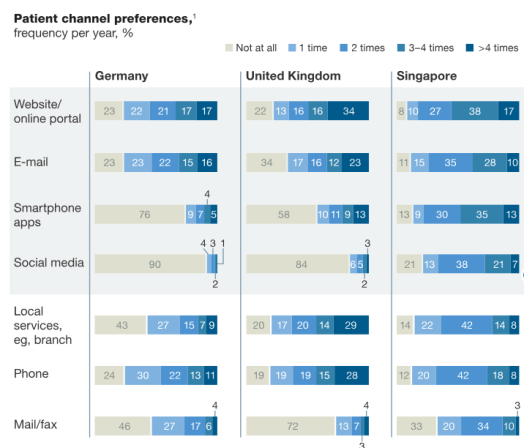
A graph showing patients preferences of the ways they receive health services (Biesdorf & Niedermann, 2014).
Imagine a time where you don’t have to wait ages to see your GP, followed by a further wait for test results and then still more waiting before being seen by a consultant. We know that changing demographic trends, an ageing population and rising rates of chronic illnesses are creating huge demand for health care and social care services. Given the trends in technology, how could our healthcare system change to better serve the population?
Data gathered from home sensors, wearable tech and mobile phones, could be sent to the doctor with a push of a button. They could run advanced analysis and design medical interventions without you leaving your house (The Telegraph, 2017). The decisions they make would then be based on far more data than would otherwise be. More informed decisions that involve the patient could lead to a better outcome for all.
To get this, a digital health system would have to be designed by medical practitioners and engineers working closely together to understand the complex healthcare challenges and their potential engineering solutions (Koul, 2018). There have been considerable advances in wearable sensors in recent years – and the arrival of the 5G wireless spectrum will provide the capacity for new sensor platforms and devices to capture and share data autonomously between devices and doctors (The Telegraph, 2017).
All in all, even with serious movement being made in digitalising healthcare, there is still room for more beneficial steps in this direction.
Refereces:
Biesdorf, S., & Niedermann, F. (2014, July). Healthcare’s digital future | McKinsey. McKinsey&Company. Retrieved from https://www.mckinsey.com/industries/healthcare-systems-and-services/our-insights/healthcares-digital-future
Haggerty, E. (2017). Healthcare and digital transformation. Network Security, 2017(8), 7–11. https://doi.org/10.1016/S1353-4858(17)30081-8
Koul, A. (2018, January). The Digitalisation of Healthcare: Why the NHS Needs Proactive Customer Engagement. Customer Experience Magazine. Retrieved from https://cxm.co.uk/digitalisation-healthcare-nhs-needs-proactive-customer-engagement/
The Telegraph. (2017). The new technologies transforming healthcare. The Telegraph. Retrieved from https://www.telegraph.co.uk/business/open-economy/new-technologies-transforming-healthcare/
 Arina and the Digital World
Interesting ideas on digitisation within healthcare here Arina. On the face of it it seems like technology would only be able to benefit the industry as experts discover new ways to diagnose and treat obscure and new diseases. One aspect that could be negative though is a possible rise in fake tech, possibly mainly arising in poorer nations? You hear of so Called ‘black market’ organs but could continued digitisation mean a rise in black market medi-tech? You also see of people being duped into purchasing fake medication as its cheaper, this could also be a side affect of the digitisation of some aspects in healthcare. It would need to be important for regulatory bodies to make sure this sort of thing happens and therefore isn’t spoilt for the consumers that need them most!
LikeLiked by 1 person
Thank you for your comment Sam! yeah i agree with you that nothing is either all good or all bad. Unfortunately not everyone has an agenda to help people, some people blindly chase profits without any concern on the community. I feel that to try and reduce the impact of black market medi-tech there should be tighter regulations within the indutry. I believe that the World Health Organisation (WHO) has got more on theire hands now that digital teh has been added to their list of things to look after. I feel that fake medication has been a problem for quite a while and therefore cant be traced back to simply digital operations. But I also think that ministries of health as well as the WHO need to tighten regulations on healhtcare digital platforms and new technology.
LikeLike
It seems that the healthcare sector is endeavouring to apply digital technology in their practices. In particular, there seems to be a strong emphasis on streamlining efficient ways to diagnose chronic conditions through the use of data sharing which I think can only be a good thing when healthcare services are generally under a lot of pressure. Your post mentions about how the ageing population is one reason to develop better technology to tackle the issue. I am wondering whether the elderly (65 and over) who are the most vulnerable demographic who are prone to having the most chronic illness will be able to access the technology. From my personal observation, they are the demographic that are not so technologically savvy with new devices or they may not be confident with it. This may pose a challenge to get this demographic to adopt the technology and I suppose the notion of not seeing a GP physically, could be something that they are not receptive towards because of the loss of human contact.
LikeLiked by 1 person
Hi Alex, thank you for comment and insights. I agree with you that it is harder for the 65 and overs to reach and use technology to access healthcare. However, i feel that the digitalisation will help them. By easing the flow of younger and timeconstrated patients into the digital platforms it allows for more time spent at each appointment and less time waiting for an appoitnemnt for the elderly. I dont think that it would be possible to move all of healthcare competely online. It is simply a tool ease the traffic of patients as well as satisfy hypocholdriacs without wastings money to see a physician in person. If you look at the link below, and the image within it you can see that most people who use A&E could have saved NHS time and money by using digital platforms to establish whats wrong with them.
https://www.door22.co.uk/work/nhs-accident-and-emergency-campaign/
So i think you raise a good point. The non-tech savy senior will benefit kind of inderectly in this case.
LikeLiked by 1 person
Hi there Arinnyyy 🙂
I’m so glad to read this article and see that someone interested in healthcare system like you. For me, I totally agree with “To digitalise” the healthcare system for the customer side. Nowadays, I have seen that lots of hospital and healthcare have been developing their treatment process (to make it better, more efficient), but not for the customer side !!
As I am one of the patients, I would really love to see how they care about us regarding the digital era. They should have implemented more channels for us, which could make it more convenient for patients to receive the treatment results and so on. Imagine I have to spend days and days going to the hospital just to listen for the results or feedback instead of getting them online at home !! I think if they could provide us with an effective/convenient system via an online platform, or even check for your sickness online, this could encourage patients to feel more willing to see a doctor.
By the way, thanks for sharing this. Keep up your good work !!
LikeLiked by 1 person