Spotify is crowned as the most successful tech start-up in the last 10 years (Figure 1) (Bullhoud,2018). Daniel Ek, the CEO of Spotify, set up the platform to help return the music industry to growth. So far, it looks like Daniel has delivered on his promise, playing a big part in first double-digit revenue growth since 1998 within the music industry (Christman, 2017). It is the world’s largest music streaming service, reaching 191 million monthly users in 2018. In perspective, this is nearly double the number for their nearest competitors like Apple Music and Amazon Music. As well as the large market share, Spotify has 87 million paying subscribers for their premium service (Iqbal, 2019; Richter, 2019). The recent valuation of the business after their launch on the stock exchange market valued the company at over $30 billion (Detrixhe, 2018). Do these promising figures mean that Spotify has disrupted the digital music economy?

Source: Bullhound
Spotify Premium Success
To zone in on Spotify’s success we first must look at its digital business model. As a start-up in 2008, Spotify has used a transformation model to enter the music streaming market as other competitors have struggled to stay afloat for long enough to even be remembered. Apple Music launched in 2014 has emulated Spotify’s model proving its success. The music streaming service uses a monetization digital business model through its freemium strategy. This means that the app makes money through paid subscriptions for the premium version (Spotify Premium) or advertising within the free version. Out of these services, Spotify Premium subscriptions are by far the biggest part of revenue. As the company started in 2008, the digital media industry has seen an increase in advertising within free platforms. Companies could foresee that consumers would accept advertising to gain a free service initially, but they didn’t foresee a rise in the anti-advertising sentiment. Ad-blocker use and advertisement fraud is on a rapid rise and businesses that rely purely on advertising revenue will struggle to compete within digital media (Netimperative, 2017). The fierce competition from ad market giants Google and Facebook, makes it hard to sustain a ‘free’ monetisation model. Therefore, the subscription option plays such a big role in Spotify’s digital business model. A recent shift in the digital media industry towards subscriptions (driven by platforms such as New York Times and Netflix) shows that consumers are more willing to pay for services that they used to get for free, if it means better quality and less ad time (Miller, 2017). Sticking to the trends, Spotify’s freemium model with a subscription element puts it in a strong position to gain large market share within music streaming services, equating for about 90% of its revenue when compared to ads (10%) (Molla, 2018).
Benefits of Spotify’s Free version
Trial
However, one cannot disregard the power of the free service and its users. With a well-established, big name competitor like Apple Music, Spotify needs a way to show consumers that their service is truly better at providing value for money. Firstly, the free version works as a trial allowing customers to understand the service and appreciate that Spotify is a better streaming platform. The more users that get hooked, the more potential for them to transfer to a premium account to avoid adverts, get offline song access, increase song quality and more.
Adapted from: agilemanifesto.org
Big data
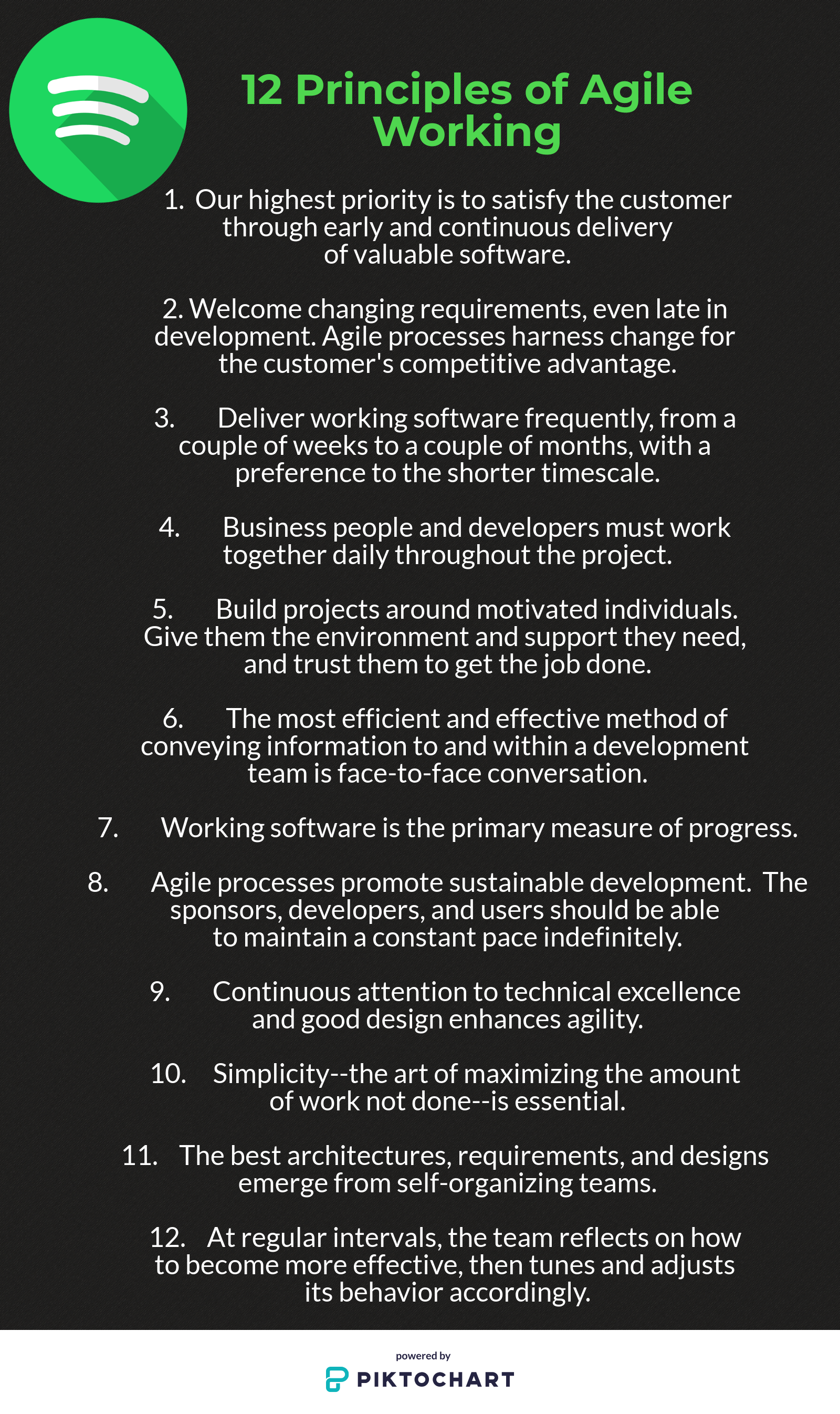
Not only does it act as advertising for Spotify, but free user generated data can be used to improve algorithms and hence, the overall service. As there are more free users currently, they generate most of the data for Spotify. The use of big data has been a hot topic recently, but if anyone is doing it right, its Spotify. Currently, Spotify uses its own Agile framework which refers to technical methodologies for collaborative and self-organizing functional teams that incorporate customer insights (Sullivan, 2018). This model allows Spotify to evolve and adapt to consumer needs at a faster speed than its competitors. The data collected from both free and paying users feeds in to the Agile model making Spotify a strogly user lead and orientated platform. The advantage Spotify has is that it understands the 12 principles of Agile working (Figure 2) as well as these principles fitting in with company’s culture and mission. To further understand the Agile way of working, feel free to watch a short video below using an example with ING Banking (Figure 3).
Source: ING Belgie YouTube Channel
Effective use of Data for Digital Marketing
Fitting in with their agile way of working Spotify has also used its data to create one of the most talked about marketing campaigns – Spotify Wrapped (Sentance, 2018). At the end of the year Spotify provide personalised content breakdown for each user as well as use billboard advertising to pick out the humorous outtakes from their data searches (Figure 4). Not only do they create a great customer service feel and position themselves as a heavily consumer focused platform, but also allow them to gain extra publicity through words of mouth on such platforms as Twitter, contributing to their continuous success (Figure 5). This campaign has contributed to positive PR for the company and to this day helps them gain new customers.

Source: Maroon 5 Twitter
In conclusion, Spotify continues its success through implementing their agile freemium digital business model to a better standard than its competitors. Both the free and premium versions are just as important as each other. Even though the free version is only bringing in 10 % of the revenue though advertisements, it still creates a ‘buzz’ for the premium service and allows Spotify to keep constantly improving its platform and marketing efforts. The more the free users get hooked to Spotify’s advantages over competitors within the free service, the more payed subscribers it will acquire. The simplified approach of integrating consumer orientated content and frameworks put Spotify at one with its listeners and so far, has helped them connect millions of people through their common love of music and streaming.
References:
Bullhound. (2018). Titans of Tech. Europe’s Flagship Companies. Retrieved from: https://www.gpbullhound.com/wp-content/uploads/2017/09/GP-Bullhound-Research-European-Titans-of-Tech-2017.pdf
Christman, E. (2017). U.S. Music Industry Sees First Double-Digit Growth in Almost 20 Years as Streaming Takes Over. Retrieved March 1, 2019, from: https://www.billboard.com/articles/business/7744268/riaa-us-music-industry-2016-revenue-double-digit-growth
Detrixhe, J. (2018). Europe’s most successful tech start-up launched 10 years ago. Retrieved March 1, 2019, from: https://qz.com/1416233/spotify-europes-most-valuable-startup-is-10-years-old/
Iqbal, M. (2019). Spotify Usage and Revenue Statistics (2018). Retrieved March 1, 2019, from: http://www.businessofapps.com/data/spotify-statistics/
Miller, R. (2017, February 2). Media companies lured by the promise of subscription revenue. Retrieved March 1, 2019, from: https://digitalcontentnext.org/blog/2017/02/02/media-companies-lured-promise-subscription-revenue/
Molla, R. (2018). Spotify’s IPO in six charts – Recode. Retrieved March 1, 2019, from: https://www.recode.net/2018/2/28/17064460/spotify-ipo-charts-music-streaming-daniel-ek
Netimperative. (2017, June 7). Ad blocking trends in 2017: Mobile increases but signs of overall slowdown. Retrieved March 1, 2019, from: http://www.netimperative.com/2017/06/ad-blocking-trends-2017-mobile-increases-signs-overall-slowdown/
Richter, F. (2019). Spotify Is Pulling Away From Apple Music. Retrieved March 1, 2019, from: https://www.statista.com/chart/8399/spotify-apple-music-paid-subscribers/
Sentance, R. (2018, November 30). The genius of Spotify Wrapped, the only marketing campaign I add to my calendar. Retrieved March 1, 2019, from: https://econsultancy.com/spotify-2018-wrapped-personalised-data/
Sullivan, J. (2018). What your business can learn from the Spotify model. Retrieved March 1, 2019, from: https://www.theceomagazine.com/business/innovation-technology/what-your-business-can-learn-from-the-spotify-model/
 Arina and the Digital World
Hi Arina,
Really interesting insight into how Spotify works. Would you say that by offering a ‘free’ version of whatever service you offer will quite often be one of the most sure fire ways to create success for a new service? By having a captive audience to begin with you’d think 9 times out of 10 they would be the most likely to then become a paying customer? And also do you think Youtube will have the same success with their paid model?
LikeLiked by 1 person
Hey Arina,
Great article, really loved gaining insight into spotify in a way I was not familiar with! Considering Spotify are clearly the most succesful music streaming service in the market right now. However, with other services such as Apple Music and Amazon Music hot on their heels, is there anything else that Spotify can do to help keep themselves as the market leaders, would be interesting to gain your opinion on whether you feel Spotify are going to stay as the No1 or fall down the ranks.
Louis
LikeLiked by 1 person
Hi Arina, I’ve also chosen Spotify for my third blog post. I agree that offering a free version is a smart decision for Spotify, and while pop-up ads may be annoying to customers, they may also prompt them to recognize the value of high-quality music and thus subscribe to value-added services – the premium version. Additionally, I think Spotify understands what customers want, and it may have something to do with the big data technology you mentioned, which helps them recommend music to customers accurately, match with customers preference. I also mentioned a video advertisement in my post. This is the video link: https://youtu.be/BaDe9Pgkpl4, I think their advertising is also a factor in their success, because they create emotional resonance with customers through storytelling, which may stimulate customers to try their service.
Wenjiao Gong
LikeLike